

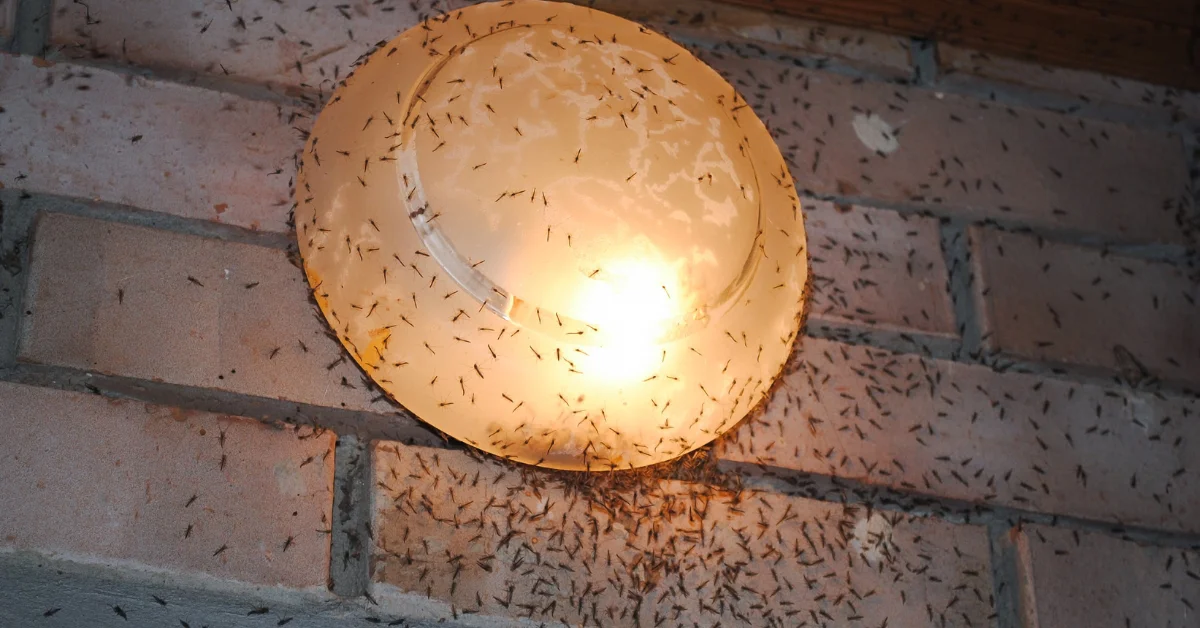
If your porch, patio, or garage lights seem to “summon” moths, gnats, beetles, and flying ants every night, it’s usually not random—it’s often a few fixable lighting choices. Insects use light cues for navigation (phototaxis), and the wrong spectrum, brightness, fixture style, and placement can turn your home into the brightest “landmark” on the block.
- Best quick win: switch from cool “daylight” bulbs to 2700K warm white (or amber) near doors.
- Big multiplier: reduce lumens and add motion/timer control.
- Often overlooked: use shielded/full-cutoff fixtures and avoid creating “light corridors.”
Using High-Blue “Daylight” Bulbs That Supercharge Insect Attraction
Choosing Cool White/Daylight LEDs Instead Of Warm/Amber (Kelvin Mistake)
When people ask, “What color light attracts bugs?” the most consistent answer is: lights with more short-wavelength energy—especially blue and near-UV—tend to attract more insects. That’s why 5000K–6500K “daylight” and many cool white LEDs often pull in more moths, beetles, flying ants, and swarming midges/gnats than 2700K warm white or amber-toned options. The common homeowner trap is thinking “brighter and whiter = safer,” then installing high-CCT bulbs at the exact places you least want insect activity: front doors, garage entries, and patios. The nuance on “Do LEDs attract bugs?” is that LEDs aren’t all the same—LEDs with less blue in their spectral output generally attract fewer insects than blue-heavy LEDs. Field research frequently reports meaningful reductions when switching to warmer/amber lighting, though results vary by species and setting—so it’s better to think in terms of reducing attraction, not “bug-proofing” your yard.
Using Bulbs That Leak UV and Assuming “Yellow Bug Lights” Repel Bugs
Another spectrum mistake is assuming the bulb “looks white” so it must be fine—or assuming a “bug bulb” repels insects. Some legacy lighting types (like certain mercury vapor and metal halide) can emit UV-adjacent wavelengths that many insects respond to strongly, but even modern lighting can still be a problem if it’s blue-forward or uses clear optics that throw light farther. This is where spectral power distribution (SPD) matters: two “warm” bulbs can behave differently depending on how narrow or broad their emission is. Many “yellow bug lights” don’t repel; they mainly shift the spectrum so the light is less attractive to lots of common night-flying insects. If you want the strongest reduction, look for amber LEDs (often described as ~590 nm narrowband) rather than cheap yellow-tinted bulbs, and be aware of tradeoffs like lower color rendering (CRI) and a different “look” on cameras. In plain terms: if your goal is fewer bugs around the door tonight, 2200K–2700K is a safe default, and narrowband amber is the next step when bug pressure is intense.
Installing Lights That Are Too Bright And Left On Too Long
Over-Lamping (Too Many Lumens) And Creating A Long-Range “Beacon”
Even with a good color temperature, brightness (lumens) can turn a simple porch light into a neighborhood-wide beacon. The brighter the source, the larger the “lure radius,” which means more insects get pulled toward your home—then they concentrate near doors, screens, and corners where they can rest. A really common mistake is swapping a standard porch bulb for a very high-lumen LED, installing a “barn light” style fixture, or using bare bulbs without a diffuser—then wondering why the bug activity feels worse than before. Another hidden factor is glare: harsh, unshielded brightness can reduce your ability to see detail (your eyes constrict), so it feels “secure” while actually making shadows and blind spots worse. A practical approach is to use the minimum effective light for the task: low output for ambiance and wayfinding, moderate output for keys/locks, and higher output only where you truly need it (and ideally triggered by motion).
Running Dusk-To-Dawn Lighting Without Controls (Timers, Motion, Curfews, Dimming)
Runtime matters as much as intensity. When lights run from dusk-to-dawn with no control, they’re advertising your home to insects for the entire night, which increases total insect “exposure time.” It can also disrupt the nighttime ecosystem—sometimes reducing natural predation patterns (bats, spiders, and other insect hunters), which can make the overall yard feel more “buggy” over time. If you’ve wondered, “Do motion sensor lights attract bugs?”—yes, while they’re on, they can attract insects, but the key is that shorter on-time typically reduces total attraction compared with all-night lighting. The best setup for most homes is layered control: a timer or smart schedule for early evening, then a “curfew” (dim or off after a set time), plus motion activation for late-night trips. If your fixtures support it, dimming is an easy win: run brighter during high-traffic hours and dim later to cut glare and reduce bug draw—just choose quality dimmable hardware to avoid annoying flicker.
Using The Wrong Fixture Design And Aiming Light Where Bugs Circulate
Picking Unshielded Decorative Fixtures That Spill Light In All Directions
Fixture design is where a lot of “warm bulb” advice falls apart. Many popular decorative options—globe lights, clear-glass lanterns, carriage/coach fixtures, and exposed filament styles—spill light sideways and upward. That extra spill creates skyglow and gives insects more angles to “lock onto” the source, increasing the swirl zone around your entry. If you want fewer insects where people gather, prioritize fixtures described as fully shielded or full cutoff (often called dark-sky compliant). These designs aim the light down where you need it (steps, walkway, lockset) instead of throwing it across walls, into landscaping, and out into the yard. You don’t have to sacrifice curb appeal, either—there are plenty of modern, attractive downlight-style sconces that look sharp and still keep the beam controlled.
Aiming Landscape Lights Upward and Creating Halo Effects With Lenses/Reflections
Uplighting trees, walls, and shrubs can look dramatic, but it’s also a reliable way to create insect magnet zones because foliage is where many insects feed, rest, and congregate. Once insects collect in that vegetation, it pulls in predators (spiders, lizards, frogs), and the whole cycle stays close to your patio and doors. A better compromise is “moonlighting” (placing a warm, shielded light higher and aiming it downward) or using tight-beam accents with baffles so you’re highlighting features without blasting the whole canopy. Also pay attention to optics: clear lenses and harsh reflectors can create hot spots, while frosted diffusers often soften the beam and reduce the long-distance “sparkle” that draws insects from farther away. Finally, look at what the light is hitting—white siding, light garage doors, and stone walls can reflect a surprising amount of light and effectively amplify the lure, even when your bulb choice is good.
Placing Lights Where They Funnel Bugs Straight Into Your House And Patio
Mounting The Brightest Light Right Next To Doors, Windows, And Seating
If you’ve ever opened the door and watched insects drift inside, you’ve seen the “porch-light trap” in action. Bugs cluster near the fixture, then when the door opens they follow airflow and bright interior light cues right into the entryway—plus they end up all over screens and door frames. To reduce that, treat your doorway like a “low-attraction zone.” Keep the light nearest the door warmer (2700K or amber) and lower output, and move the brighter, higher-output fixture away from the entrance—for example, aim brighter light toward the driveway side or a detached area where it won’t dump insects onto the threshold. If you’re asking, “Why are bugs swarming my porch light?” it’s usually a combination of spectrum + brightness + proximity to a landing/entry point. A small adjustment—like swapping to a warm bulb and adding a shielded sconce—often makes the door area noticeably calmer within a few nights.
Creating “Insect Highways” With Continuous Lighting and Stacking Attractants Nearby
Many homes accidentally create an “insect corridor” by lining up multiple fixtures—soffit/eave lights, path lights, fence cap lights, string lights—so insects hop from one pool of light to the next and end up concentrated where people sit. Breaking that chain can be as simple as removing a few bulbs, spacing fixtures farther apart, or switching some lights to staggered motion activation so they aren’t all on at once. Placement near insect sources matters too: lights installed beside standing water, dense plants, damp mulch, trash bins, or compost will magnify the issue because you’re combining a light attractant with a habitat/food attractant. If your yard is irrigated, even shifting watering to earlier in the day can reduce nighttime humidity pockets that fuel gnats and midges around lit areas. The goal isn’t to make your property dark—it’s to stop lighting up the exact spots where insects naturally thrive and then giving them a straight, bright path to your patio.
Missing The “Last 10%” Details That Keep Bugs Coming Back
Neglecting Fixture Maintenance That Increases Hot Spots, Odors, and Resting Places
The last stretch is boring—but it’s often the difference between “better” and “finally comfortable.” Dirty lenses and fixtures can create uneven distribution and bright hot spots that increase attraction, while built-up debris around mounts becomes a convenient resting place for insects (and a prime hunting zone for spiders). Regularly cleaning lenses, knocking down webs, and checking that covers sit flush helps keep the beam predictable and reduces harborage. It’s also smart to verify the fixture is appropriate for outdoor exposure (look for solid weather sealing and outdoor-rated construction) so you’re not creating damp, protected micro-spaces where insects can tuck in. If you notice bugs collecting inside the fixture, that’s often a clue that gaskets are failing or there are gaps—fixing the seal can cut down on the “bugs living in the light” problem that no bulb swap can fully solve.
Relying On Bug Zappers Instead Of Fixing Root Causes (Plus a Fix-First Checklist)
Bug zappers and gimmicky “scented” lights are popular because they feel satisfying, but they usually don’t address why insects are gathering at your entry in the first place. Many outdoor zappers kill lots of non-target insects, and they typically don’t make a big dent in biting mosquito pressure because mosquitoes are driven more by CO₂, body heat, and human scent than by porch lights. A better approach is integrated pest management (IPM): reduce attractants (light, water, harborage), then layer in targeted control when needed. If you want the biggest reduction fast, start with lighting changes you can do tonight—and if you’re still fighting heavy swarms around doors, patios, or the garage, it may be time to bring in a pro who can evaluate both lighting and pest pressure (ants, mosquitoes, flies, gnats) together. For homeowners and property managers in Gonzales, LA, Delta Pest Services can help you pinpoint what’s drawing pests to the structure and recommend practical fixes—without pushing you into overkill. If you’d like a local, straightforward plan for a more comfortable outdoor space, contact Delta Pest Services for pest control in Gonzales, LA and get advice tailored to your home’s layout and pressure points.
- Swap 6500K–5000K bulbs near doors to 2700K (or amber where bug pressure is intense).
- Reduce lumens to the minimum you need; avoid bare bulbs and harsh glare.
- Upgrade to fully shielded/full-cutoff fixtures that aim light down.
- Add motion sensors, timers, or smart schedules; consider a late-night dim/off curfew.
- Move the brightest light away from doors and away from water/vegetation where possible.
- Do a quick 3–5 night before/after test and track activity (a phone lux meter can help compare relative brightness).
- Shopping terms that help: “warm LED porch bulb 2700K,” “amber LED bug light,” “full cutoff wall sconce,” “motion sensor floodlight warm CCT,” “dark-sky compliant outdoor fixture.”
- Sources to learn more:
- DarkSky International — guidance on shielding and warm CCT outdoor lighting: https://darksky.org/
- American Medical Association (AMA) — community guidance on high-intensity LED lighting and blue-rich light concerns: https://www.ama-assn.org/
- Owens, A.C.S. & Lewis, S.M. (2018) — review on ecological impacts of artificial light at night (ALAN): https://royalsocietypublishing.org/
- van Langevelde, F. et al. (2011) — field research on how spectral composition affects insect attraction: https://www.nature.com/